DTO-BioFlow’s Demonstration Use Case 6 (DUC6), “Lower-Trophic Level Biomass Monitoring to Inform Ocean Governance”, continues to demonstrate how innovative biodiversity monitoring can support more informed marine management. Recent outreach activities by the SINTEF Ocean highlighted the growing role of biodiversity data within the European Digital Twin Ocean (DTO) and the importance of engaging scientific and stakeholder communities in shaping future ocean governance.
Biodiversity Data Meets the Digital Twin Ocean at Norwegian Mission Ocean Day
At the Norwegian Mission Ocean Day, held on 4 December 2025 in Trondheim, Norway, DTO-BioFlow and SINTEF Ocean presented the latest developments from DUC6 under the theme “Biodiversity Data and the Digital Twin Ocean.” This contribution formed part of the broader DTO-BioFlow matchmaking event, bringing together researchers, policymakers, businesses, and public authorities working towards the goals of the EU Mission “Restore Our Ocean and Waters by 2030.”
The presentation was delivered by SINTEF Ocean researchers Muriel Dunn, Raymond Nepstad, Dana King, Tor Nordam, and Lara Veylit, who showcased how biodiversity observations can be integrated into digital ocean infrastructures to support ecosystem-based management and informed ocean governance.
The team highlighted a central challenge facing marine science today: vast quantities of biodiversity data are being generated through a wide range of monitoring methods, including environmental DNA (eDNA) observations, plankton imaging technologies, passive acoustic monitoring, and other emerging biodiversity observation systems.
While these datasets contain valuable information about marine ecosystem health, much of the information remains underutilised or fragmented across different platforms. DTO-BioFlow aims to unlock this “sleeping” biodiversity data by making it accessible, interoperable, and ready for integration into the Digital Twin Ocean. This approach enables biodiversity information to be combined with environmental and oceanographic data, creating a richer picture of marine ecosystem dynamics and pressures.
The presentation also showcased the DUC6 demonstrator focused on monitoring lower-trophic-level biomass—particularly plankton communities that form the foundation of marine food webs. By integrating biodiversity observations into digital tools, DUC6 supports more effective ecosystem assessments and evidence-based ocean governance.
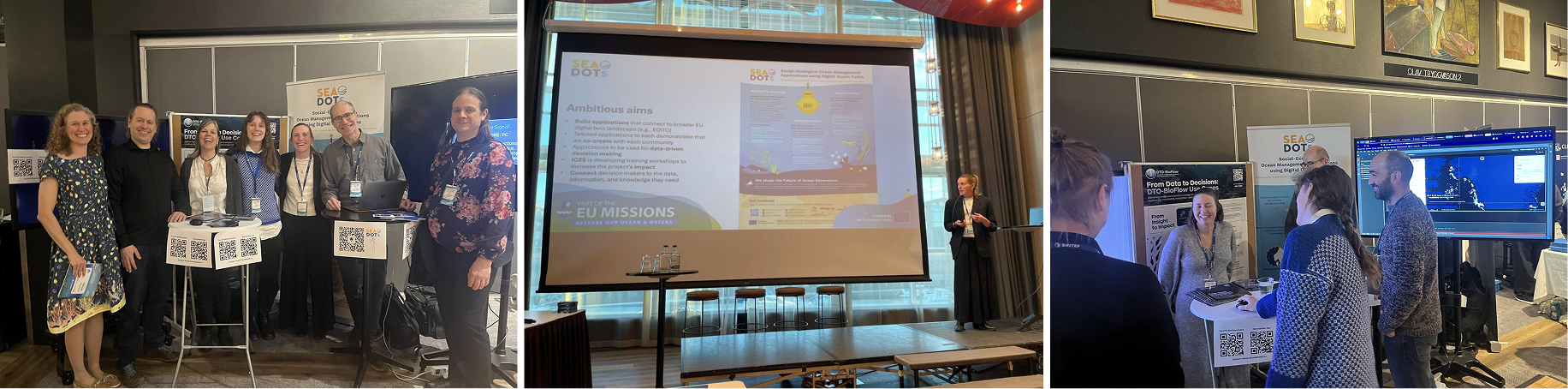
Photo by SINTEF Ocean team during the Norwegian Ocean Days, 4 Dec 2025, Trondheim, Norway
A key use case presented during the event focused on harmful algal blooms (HABs), which are common in northern temperate ecosystems such as those found along the Norwegian coast. The DUC6 demonstrator highlights how changes in lower-trophic-level biomass can influence ecosystem health and, in some cases, contribute to bloom events that impact marine life, aquaculture, and coastal communities. By combining biodiversity observations with digital ocean technologies, DTO-BioFlow is helping stakeholders better understand and anticipate these ecosystem changes, supporting more informed marine planning and management.
Bringing DTO-BioFlow to the Ocean Sciences Community at OSM26
Researchers from SINTEF Ocean participated in the Ocean Sciences Meeting 2026 (OSM26), held in Glasgow, Scotland, from 22–27 February 2026. The conference, jointly organised by the American Geophysical Union (AGU), the Association for the Sciences of Limnology and Oceanography (ASLO), and The Oceanography Society (TOS), brought together the global ocean science community to share knowledge, present new research, and foster collaboration.
During the event, SINTEF Ocean presented a DTO-BioFlow poster titled “Making sense of underwater particle images with PyOPIA”, authored by Raymond Nepstad, Dana King, Tor Nordam, Emlyn Davies (SINTEF Ocean) and Arsalan Mostaani (Norwegian University of Science and Technology). The poster showcased PyOPIA (Python Ocean Particle Image Analysis), an open-source Python library for processing large volumes of particle image data from instruments such as SilCam, LISST-Holo, and UVP-type systems. The tool provides a standardised and user-customisable pipeline for image cleaning, segmentation, particle measurement, and CNN-based classification, with outputs stored in structured netCDF formats for downstream analysis.
Building on this work, the PyOPIA pipeline has since been extended with new features that simplify the upload and management of particle imaging data, improving usability and enabling broader access for researchers and stakeholders. These enhancements further support DTO-BioFlow’s objective of unlocking biodiversity-relevant data and integrating it into the Digital Twin Ocean framework.
Participation in OSM26 also provided valuable opportunities to exchange ideas, gather feedback, and connect with researchers working on ocean monitoring, biodiversity observations, and digital ocean technologies.
Advancing Biodiversity-Informed Ocean Governance
Together, the Norwegian Mission Ocean Day and OSM26 demonstrated the growing interest in integrating biodiversity observations into digital ocean systems. Through DUC6, DTO-BioFlow is helping bridge the gap between biodiversity monitoring and decision-making by transforming diverse biological observations into actionable information for ecosystem management.
As the project continues, the integration of biodiversity data into the European Digital Twin Ocean will play an increasingly important role in supporting sustainable ocean governance, improving ecosystem assessments, and enabling more informed responses to challenges such as harmful algal blooms and other ecosystem pressures.
Explore DTO-BioFlow use cases to discover how project tools are being developed and tested in real contexts and follow the project channels to stay informed about upcoming matchmaking opportunities and future engagement events.