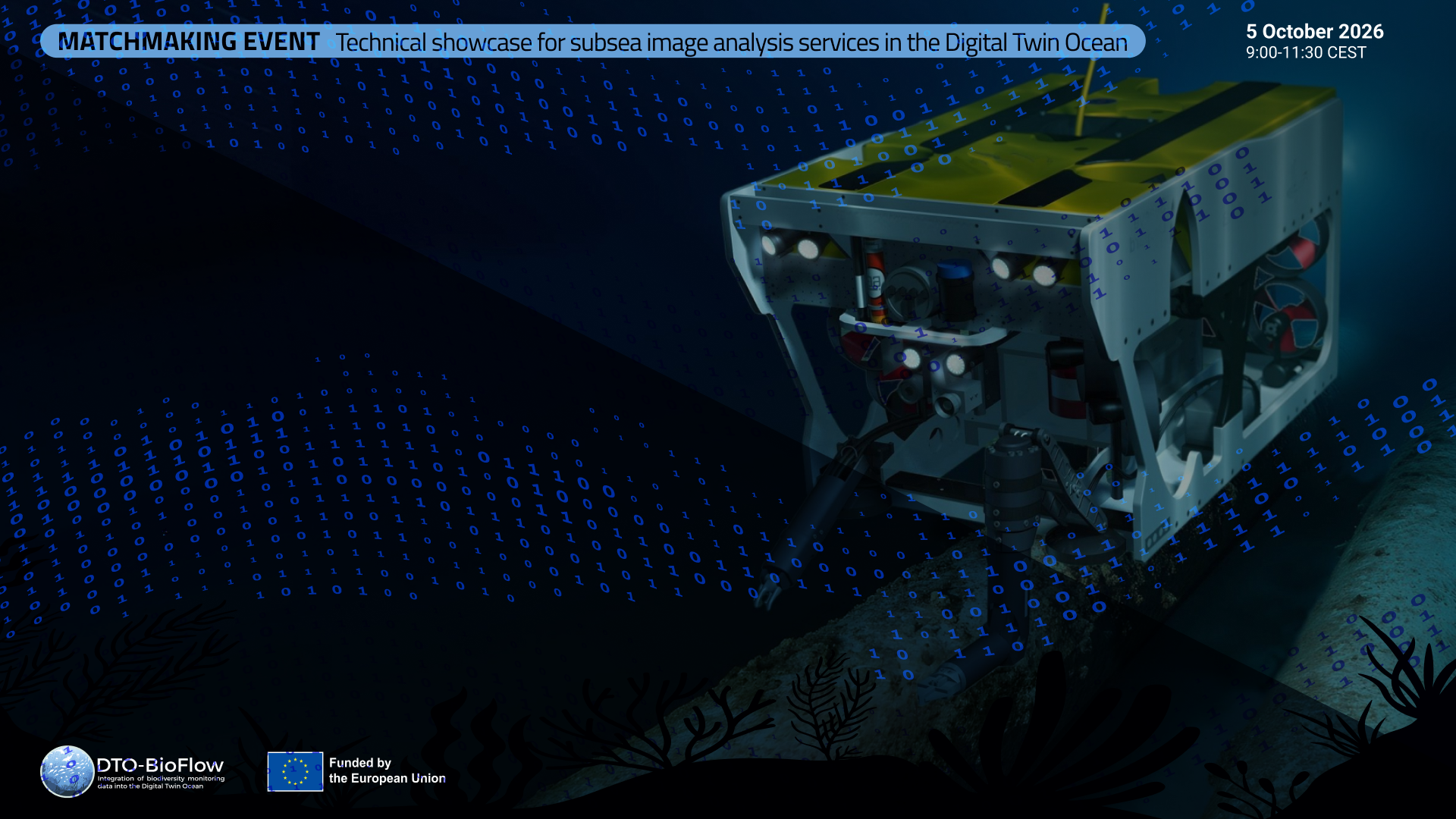
On 5 October 2026, DTO-BioFlow hosted an online technical showcase that brought together developers, infrastructure providers, and researchers to explore SUBSIM, a subsea image analysis service within the European Digital Twin Ocean (EDITO).
The event focused on SUBSIM’s architecture, technical workflows, and integration with EDITO, the European Digital Twin Ocean portal that provides access to digital tools, data, and services for ocean research and management. The showcase demonstrated that SUBSIM’s tools and resources can help researchers and developers explore subsea image analysis for marine research and ocean monitoring.
Explore the event resources, including the presentations, Q&A, poll results, and recording of the Matchmaking event on "Technical Showcase for Subsea Image Analysis Services in the Digital Twin Ocean."
Exploring SUBSIM’s Architecture and Technical Capabilities
Matthias Obst (University of Gothenburg) introduced SUBSIM’s architecture and functionality, outlining the service’s technical foundations and capabilities.
Louis Fiorina (University of Gothenburg), Ghaith Chaabane (Technical University of Ostrava) and Victor Anton (Wildlife.ai) presented technical notebooks and explored the service’s codebase, documentation, tutorials and execution within EDITO. Their presentations offered practical insights into the workflows and resources available to developers and researchers.
Connecting Technical Workflows with Scientific Applications
The showcase also explored how subsea image analysis can support scientific research and ocean monitoring.
Matthias Obst (University of Gothenburg) and Vinzent Ferfers (University of Kiel) presented examples of users and applications, while Tuomas Rossi (CSC – IT Center for Science) presented functionality for high-performance computing (HPC), scalability and portability, highlighting important considerations for running image analysis workflows across computing environments.
The programme concluded with a Q&A session, giving participants an opportunity to raise technical questions and discuss the service’s implementation and potential applications.

What Did We Achieve?
The technical showcase highlighted three key contributions to the European Digital Twin Oceans:
- Advancing marine biodiversity research: Showcased SUBSIM and its subsea image analysis capabilities as technology that can support marine biodiversity research within the Digital Twin Ocean.
- Lowering barriers to data-driven ocean science: Demonstrated technical workflows, notebooks, and supporting resources that can help researchers access and work with large datasets and automated ocean observation technologies.
- Connecting scientific applications with ocean management: Presented practical examples of how subsea image analysis can generate scientific knowledge to inform ocean monitoring and management.
Together, the presentations and discussions helped make SUBSIM’s technical capabilities and implementation considerations more accessible to potential users.
Supporting the European Digital Twin Ocean
By connecting technical expertise with scientific applications, DTO-BioFlow contributed to knowledge exchange on subsea image analysis services and their potential role in marine research and ocean monitoring.
The showcase highlighted the importance of reusable workflows, accessible documentation, and scalable computing resources in helping developers and researchers explore and apply digital services within the evolving European Digital Twin Ocean ecosystem.
Missed the event? Visit the official event page for available resources and updates.
Continue the conversation
Join DTO-BioFlow’s next online event, “From Insight to Impact: Integrating Marine Biodiversity into Digital Twins of the Ocean,” on 10 November 2026, from 14:00 to 16:00 CET.
Discover how marine biodiversity data and knowledge can be integrated into digital twins of the ocean and contribute to future research, collaboration, and ocean management.