Back at the Digital Ocean Forum for the second year, DTO-BioFlow arrived with new achievements, deeper insights, and a growing role within the EDITO community. The project’s progress over the past year was clear, sparking renewed energy and shared ambition for Europe’s Digital Twin Ocean.
DTO-BioFlow was proud to participate in the Digital Ocean Forum 2025, a key annual event bringing together EU policymakers, marine scientists, industry actors, and digital innovators to advance the co-construction of the EU Digital Ocean Platform under EDITO, building on Copernicus Marine Service and EMODnet. This year’s edition centred on aligning scientific, technical, and policy communities around the development of shared digital services, data infrastructures, and governance approaches for a fully operational Digital Twin Ocean. Within this context, DTO-BioFlow had a valuable space to demonstrate how biodiversity observations are being transformed into interoperable, policy-relevant information that can support modelling, decision-making, and future ocean management services.
Connecting Biodiversity Data to European Digital Ocean Policy
The Forum emphasised the policy ambitions of EDITO within the EU Mission Restore our Ocean and Waters. DTO-BioFlow directly contributes to these ambitions by enabling a sustained and interoperable flow of biodiversity monitoring data into EDITO, turning previously “sleeping” datasets into actionable knowledge for ocean governance. This work strengthens Europe’s capacity to respond to challenges such as ecosystem degradation, spatial planning needs, and climate-related impacts.
A key moment on the first day was the presentation delivered by Klaas Deneudt, the DTO-BioFlow Project Coordinator from the Flanders Marine Institute (VLIZ). His presentation offered a clear narrative of how DTO-BioFlow is bridging the gap between diverse biodiversity observations and the data infrastructure behind EDITO.
He highlighted why biodiversity information is essential for EDITO’s future decision-support tools, from ecosystem management to sustainable blue economy planning, and how DTO-BioFlow is directly contributing to bringing those data into EDITO’s digital ecosystem.
Klaas walked the audience through the project’s work, and the data flows for data onboarding being developed for classical, as well as new biodiversity data types (from eDNA and plankton imaging to biologging and passive acoustics). He illustrated how DTO-BioFlow engaged with data providers through its FSTP calls, with the aim of bringing them into EDITO’s infrastructure through a streamlined ingestion pipeline.
Thanks to this work, more than 5.1 million biodiversity observations and 58 datasets have already been onboarded as part of DTO-BioFlow, marking substantial progress toward a sustainable European data flow. Klaas also showed how these datasets support the eight Demonstrator Use Cases of DTO-BioFlow, which translate the data into real-world examples of future EDITO applications, such as improved spatial planning for mariculture.
He concluded with lessons learned and next steps, noting ongoing challenges like data reformatting and quality control, while outlining the move toward direct connections with the EDITO data lake to ensure long-term sustainability.
"It was impressive to see how the DTO is moving forward and it is great to see how DTO-BioFlow is contributing to its realisation."

Photo credit to the VLIZ team on-site: Klaas Deneudt, Head of the Marine Observation Centre at the Flanders Marine Institute (VLIZ) and DTO-BioFlow Coordinator, during his presentation on Breakout Session 1.
On Day 2, two excellent presentations were delivered by Jan Reubens and Stijn Vermaere from the Flanders Marine Institute (VLIZ) explaining "How to onboard data on EDITO - Use Case: European Tracking Network". They introduced the biologging onboarding process of the European Tracking Network (ETN) dataflows into the DTO-BioFlow data lake.
ETN plays a central role in several DTO-BioFlow dataflows, particularly biologging and passive acoustic data, as it serves as a key integrator between data collection, EMODnet, and DTO-BioFlow. It also acts as the main infrastructure enabling DTO-BioFlow to incorporate animal-tracking and acoustic data into Europe’s Digital Twin Ocean.
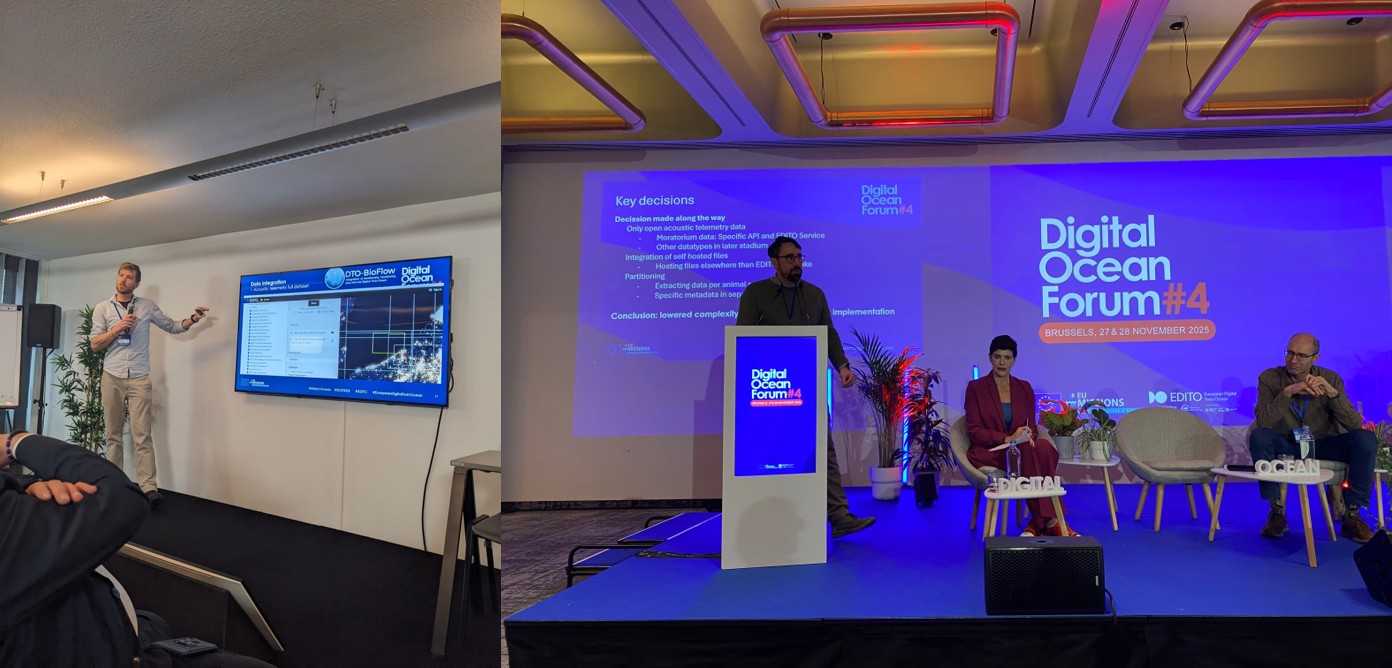
Photo credit to the VLIZ team on-site: Stijn Vermaere and Jan Reubens from VLIZ during their presentations on "How to onboard data on EDITO - Use Case: European Tracking Network."
Showcasing DTO-BioFlow at the Joint Exhibition Booth
DTO-BioFlow also joined 11 other EU-funded digital ocean initiatives at the shared exhibition booth dedicated to biodiversity integration.
The booth was a success with almost 300 visitors learning more about how DTO-BioFlow is bringing biodiversity data into the EU DTO, the data flows that we are creating, and the demonstrator use cases that bring these data into policy and management-relevant applications. Visitors were particularly drawn to DTO-BioFlow’s interactive puzzles, which offered an accessible way to understand how raw biodiversity observations are transformed into digital services for EDITO.
These hands-on tools sparked conversations around interoperability, user needs, and the added value of bringing complex data flows to life in a visual and engaging format.
"DTO-BioFlow was proud to be able to showcase the first biological datasets contributed to the EU DTO with our booth and as part of the data onboarding sessions. The project is contributing to establish the dataflows to populate the EU DTO with high quality biodiversity data, which is key to support data-driven tools and applications to improve our management and understanding of marine systems."
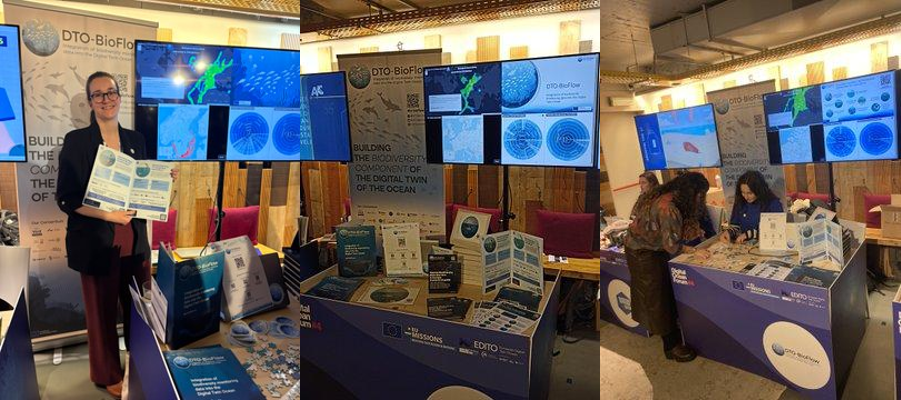
Photo credit to the VLIZ team on-site: Highlight at the DTO-BioFlow Booth
A Step Forward for Collaboration and Uptake
At this year’s Forum, DTO-BioFlow demonstrated that integrating biodiversity into the Digital Twin Ocean is no longer a distant aspiration but a concrete reality taking shape. The conversations sparked in Brussels showed a community ready to collaborate, innovate, and push boundaries. With stronger connections and clearer priorities emerging from this year’s Forum, DTO-BioFlow is well-positioned to influence the next steps toward a fully operational Digital Twin Ocean.
We extend our warm thanks to everyone who visited our booth, attended our presentation, and contributed to the lively discussions throughout the day.
