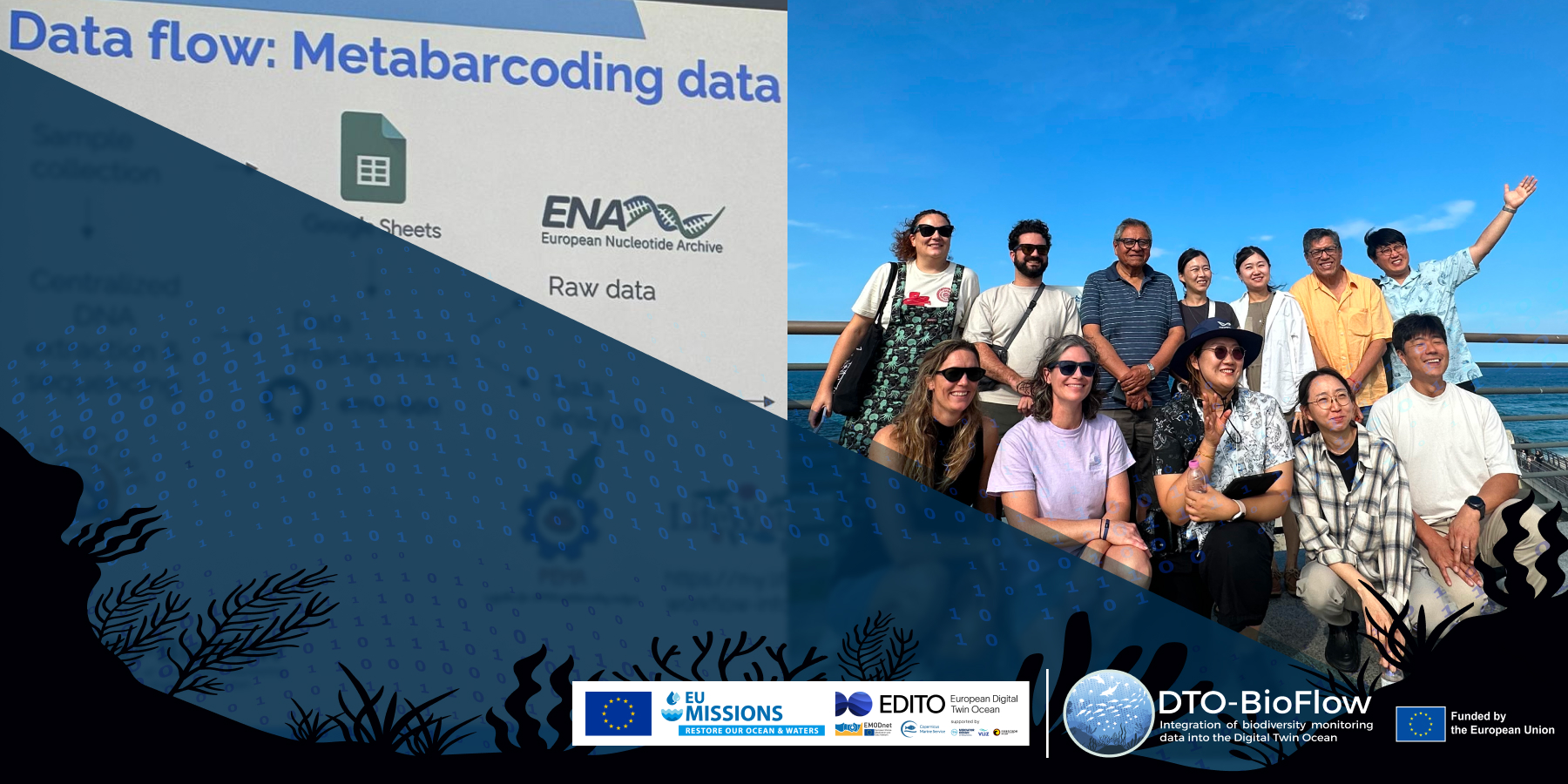
How can marine biodiversity monitoring, genomics data, and interoperable data infrastructures help us better understand and respond to changes in our oceans?
This question was central to the ARMS Workshop, held from 24 August to 2 September in South Korea under the theme “Capacity Building for Ocean Monitoring in Response to Climate Change in the APEC Region.” Organised by Hyun-Sung Yang, Ph.D., Professor and Director/Senior Research Scientist at the Korea·South Pacific Ocean Research Center (KSORC) and Korea Institute of Ocean Science & Technology (KIOST), the workshop brought together experts and practitioners from research institutions and universities across Europe, the United States and the Asia-Pacific region.
For DTO-BioFlow, the workshop provided an opportunity to highlight how biodiversity monitoring data can move beyond collection in the field to become standardised, interoperable and accessible data products that contribute to the Digital Twin Ocean.
Through expert presentations, technical lectures, case studies, policy discussions and interactive sessions, participants explored practical approaches to strengthening ocean monitoring and building more resilient marine ecosystems in response to climate change.
From ARMS and eDNA to the Digital Twin Ocean
A major focus of the workshop was the deployment and retrieval of Autonomous Reef Monitoring Structures (ARMS) and their role in standardised monitoring of benthic marine biodiversity.
ARMS provide a standardised approach for sampling marine communities, while environmental DNA (eDNA) metabarcoding and genomics can be used to assess and characterise the biodiversity captured through these monitoring efforts. Together, these approaches offer valuable opportunities to monitor marine ecosystems and detect changes in biodiversity over time.
However, generating biodiversity observations is only the first step. To unlock their full value, these data need to be processed, standardised, documented and connected to interoperable infrastructures, allowing them to be discovered, accessed, combined and reused by researchers and other users.
This connection between biodiversity monitoring and data infrastructure was at the heart of DTO-BioFlow’s contribution to the workshop.
Connecting genomics data with EDITO
Christina Pavloudi, Data Scientist at the European Marine Biological Resource Centre (EMBRC), representing DTO-BioFlow, presented how genomics data generated through marine biodiversity monitoring can be transformed into interoperable and accessible data products.
Using EMO BON as an example of a monitoring network delivering genomics data to the Digital Twin Ocean ecosystem, her presentation demonstrated how data flows have been developed towards EDITO, including processing and analysis of genomics data, creation of Darwin Core datasets, and access to the resulting data through the EDITO Data Lake.
The example illustrated an important principle for DTO-BioFlow: effective biodiversity monitoring depends not only on collecting high-quality observations, but also on ensuring that the resulting data can flow into shared and interoperable digital infrastructures.
“What stood out at the workshop was the opportunity to connect field-based biodiversity monitoring with the wider data ecosystem. ARMS and eDNA can generate valuable insights into marine biodiversity, but making these data interoperable and accessible is essential if we want them to contribute to long-term monitoring and the development of the Digital Twin Ocean.”
— Christina Pavloudi, EMBRC-ERIC / DTO-BioFlow
By demonstrating the journey from field-based monitoring and genomics analysis to standardised datasets and digital infrastructures, DTO-BioFlow showed how biodiversity observations can become more discoverable, reusable and valuable within the wider Digital Twin Ocean.
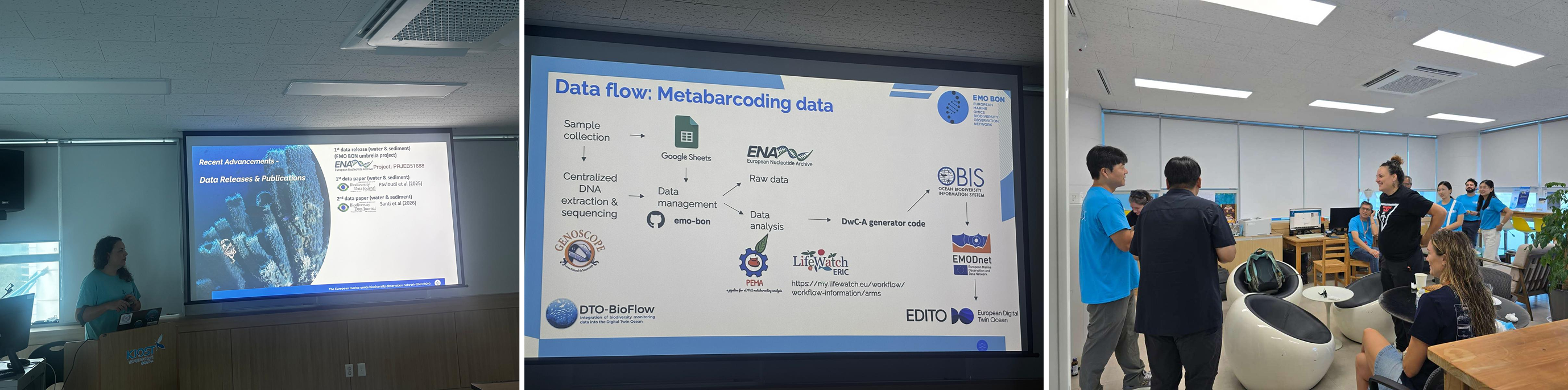
Image taken during ARM Workshop 2026: Christina Pavloudi during her presentation (left and middle) and group discussion (right)
Three coupled technologies for ocean monitoring
The workshop brought together three interconnected approaches for monitoring marine ecosystems and understanding their response to climate change:
- Autonomous Reef Monitoring Structures (ARMS) – providing standardised sampling for benthic ecosystem and biodiversity monitoring;
- Environmental DNA (eDNA) metabarcoding – enabling marine biodiversity assessment through genetic material collected from environmental samples; and
- Satellite remote sensing – providing broad-scale observations of ocean and environmental conditions.
For DTO-BioFlow, the combination of these approaches highlights the growing diversity and volume of observations available for understanding marine ecosystems — and the corresponding need for robust data management, interoperability and integration.
Connecting observations from different monitoring technologies and networks can help build a more comprehensive picture of ocean biodiversity and environmental change. Digital Twin infrastructures can play an important role in bringing these different sources of knowledge together and making them available for wider scientific and societal use.
Strengthening international collaboration for long-term biodiversity monitoring
The workshop also demonstrated that advancing marine biodiversity monitoring requires collaboration across countries, disciplines and monitoring networks.
Participants exchanged knowledge on ARMS deployment and processing, eDNA metabarcoding, genomics, satellite observations and data management, while discussing the added value of Digital Twins and the importance of ensuring that biodiversity data can flow into interoperable repositories and integrators.
For DTO-BioFlow, these discussions reinforced the importance of connecting monitoring communities, biodiversity data providers and digital infrastructures. They also opened opportunities for stronger collaboration between researchers and institutions in Europe, the United States and the APEC region.
As reflected by the workshop participant:
“The workshop brought together people from different backgrounds, expertise and countries. Everyone managed to grasp how ARMS can be used for benthic biodiversity monitoring, what is needed to process ARMS samples, the potential of eDNA metabarcoding, and the added value of Digital Twins. It also highlighted how we should manage metadata and ensure that data can flow to interoperable repositories and integrators, and ultimately, how necessary international collaboration is for long-term biological monitoring.”
The ARMS Workshop marked an important step towards building long-lasting international collaborations around marine biodiversity monitoring. It also demonstrated the value of connecting standardised observations, genomics data and interoperable digital infrastructures to strengthen our understanding of changing marine ecosystems.
For DTO-BioFlow, these connections are essential to advancing a more open, integrated and data-driven Digital Twin Ocean, where biodiversity data can move from observation to insight and ultimately support better understanding and management of our oceans.
Discover how DTO-BioFlow is connecting marine biodiversity data, innovative monitoring approaches and interoperable digital infrastructures to advance the Digital Twin Ocean.
Explore DTO-BioFlow and follow us on LinkedIn and Bluesky to stay up to date with the latest project results and developments.