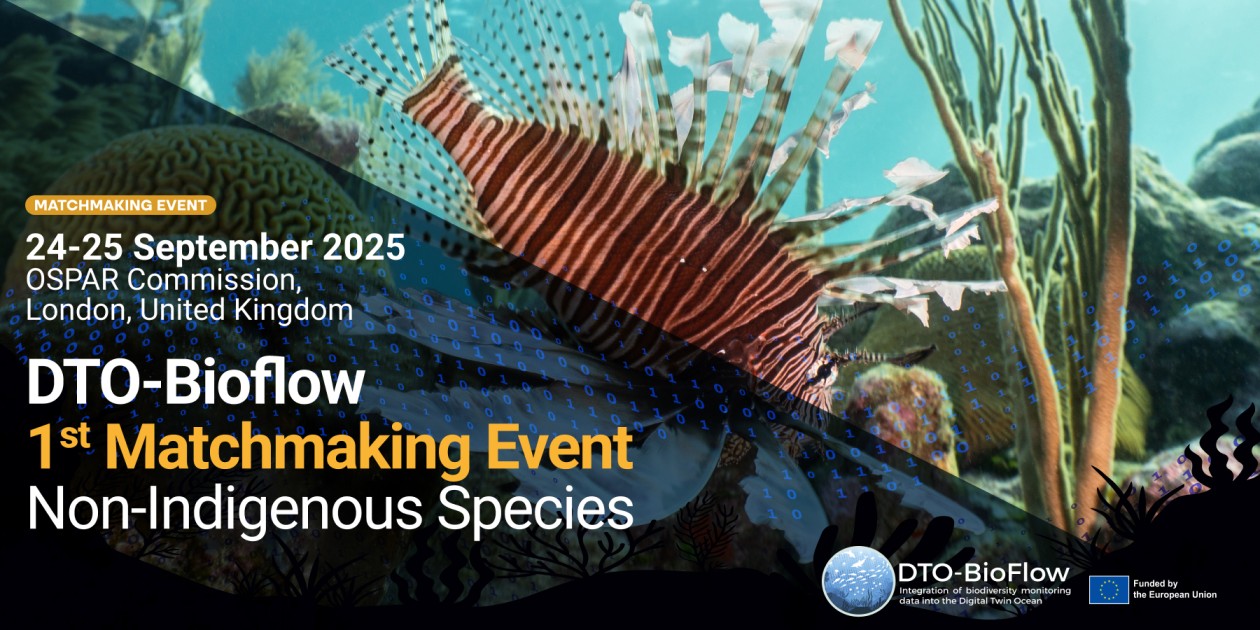
DTO-Bioflow 1st Matchmaking Event – Demonstratior Use Case 1 on Non-Indigenous Species
Third Informal Consultation Session of the Joint HELCOM/OSPAR Task Group on Ballast Water Management Convention (BWMC) and Biofouling (IC JTG Ballast & Biofouling 3-2025)
As DTO-BioFlow enters a phase where its tools and services are ready for engagement beyond the research domain, this first matchmaking event focuses on connecting project developments with policy and regulatory stakeholders working on non-indigenous species (NIS).
The event takes place in the framework of the Joint HELCOM/OSPAR Task Group on Ballast Water Management and Biofouling, providing a timely opportunity to explore how genetic monitoring and associated analytical tools can support concrete regulatory decisions related to invasive species in the marine environment.
Focus and Objectives
This matchmaking session centres on Demonstrator Use Case 1 (DUC 1), which addresses the use of genetic data for monitoring, assessment, and management of non-indigenous species. The discussion explores how genetic observations and analytical outputs can be integrated into existing regulatory workflows, moving from detection and reporting towards assessment, mitigation, and control.
Key objectives
- Presenting European and Swedish genetic monitoring programmes and their analytical tools.
- Demonstrating how genetic data can be operationalised for surveillance, reporting, and decision support.
- Exploring pathways for integrating genetic monitoring data into regional data infrastructures.
- Engaging directly with policy, legal, and technical representatives responsible for decision-making in the context of ballast water and biofouling.
DTO-BioFlow Contribution
DTO-BioFlow contributes through the presentation of genetic monitoring programmes and analytical applications that support decision-making on non-indigenous species. These applications enable authorities to move beyond early detection, supporting risk prioritisation and informing management responses, including mitigation and control measures in sensitive marine areas.
Why This Matters
The matchmaking event represents an important step in aligning DTO-BioFlow outputs with real-world governance needs. By engaging directly with regional conventions and regulatory bodies, the session supports a shift in how genetic data is positioned—bridging the gap between scientific evidence and operational decision-making.
The discussions are expected to inform future collaboration, technical alignment, and protocol development, helping ensure that genetic monitoring data becomes interoperable, trusted, and usable within marine policy and management frameworks linked to the European Digital Twin Ocean.
Further updates will follow as outcomes from the session translate into concrete next steps within DTO-BioFlow and its engagement with HELCOM and OSPAR processes.